
|
|
General HydroStatics
Ship Stability Software |
|
Command of the Week
(New or interesting aspects of GHS that you may not know about) |
|
Caution with ADDed LPA
|
|
A recent COW shows
lateral-plane areas being incidentally attached to weight items.
It features sailboat rigging elements being represented by weights
and fixed lateral-plane areas.
The entire rig, including sails, is represented by ADD commands. This works for finding wind heeling moment at zero heel angle, but in general, it is a bad idea. Does it not seem odd that the ADD command offers to include LPA? Well, yes, because ADDed weight items add weights to the vessel model without knowing their sizes and shapes. Convenience is to blame: it avoids having to create geometry that has no other purpose than adding a bit of lateral-plane area in cases where LPA is used only at zero heel. We're referring to calculation methods where the shape of the heeling-moment curve as a function of heel angle follows a predetermined curve based on its value at zero. In reality, lateral plane is a lateral projection derived from a geometrical shape. If the orientation of the thing changes, its lateral-plane properties change too, and not necessarily according to a predictable curve. In summary, LPA, being a number derived from geometry, does not logically belong in the same package with a weight. But if you care about LPA only at zero heel, and the thing whose properties you are considering never goes below the waterplane, then you can omit the effort of modeling the geometry and attach the LPA directly to the weight item -- with caution, promising to never use LPA at other angles. And be aware that the center of that LPA will be derived from its center of gravity. Now, what if finding that LPA number is best done by modeling the geometry of the object? In that event, you best add a sail/superstructure part to the geometric model. Its weight then resides separately in the results of WEIGHT or ADD commands. Sometimes the weight and CG of an object have to be calculated from its geometry as well. That's what the "Create segment" feature in DB EditLSWt and EditFixWt do. Since they are only about making distributed weight items for the database, the geometry that gets generated in the process was not readily available as an addition to the vessel's geometric model -- until now. As of today you can import any or all of the geometry that was involved in deriving weights, and include it in the same vessel model or any other vessel model. The tool to use is here in this run file. Watch how it works. |
|
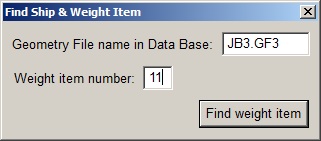
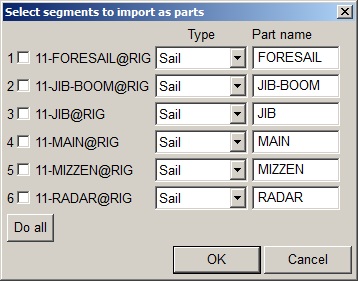
| After you indicate which ship in the database you want to import from -- along with the item number -- you get the list of the segments that have geometry. |
|
|
If more than one weight item has elements you want to import as sail/superstructure,
you have to get each item separately, but they can all go into the same vessel model.
You can assign names or keep the names from the create-segment activity.
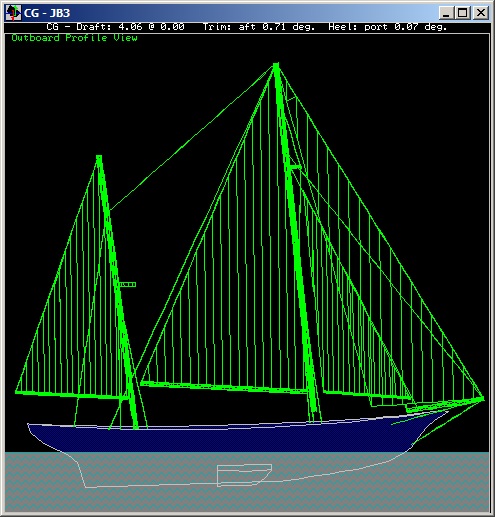
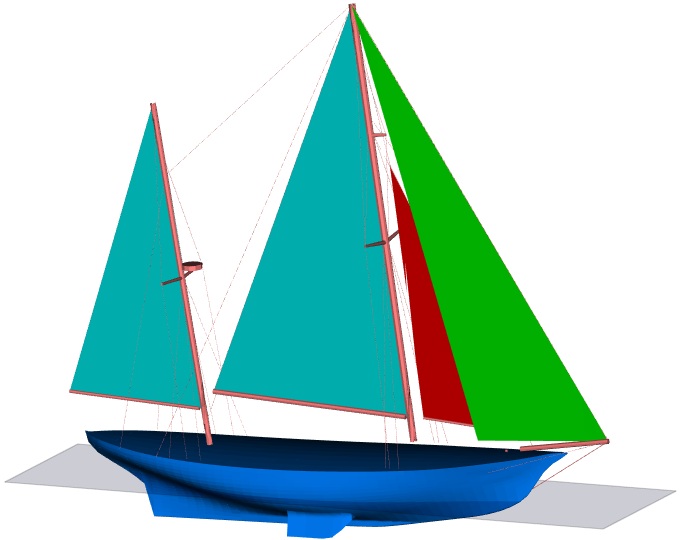
Here is Jubilee III sporting sail parts after they were imported from the rig elements. |
|
|
|
|
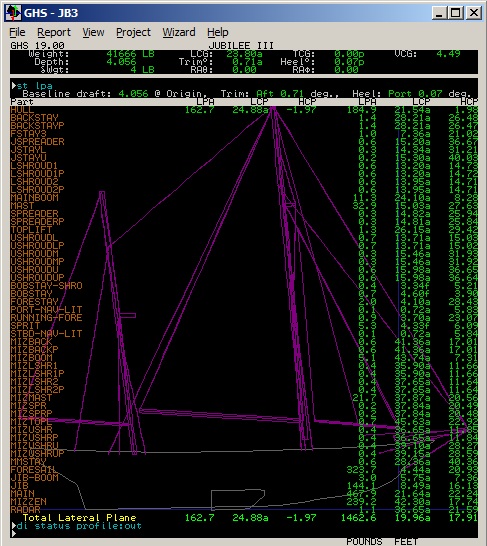
In the first try (before the table shown above was produced)
it was noticed that the LPA from the rig got doubled because the ADDs still carried LPA values.
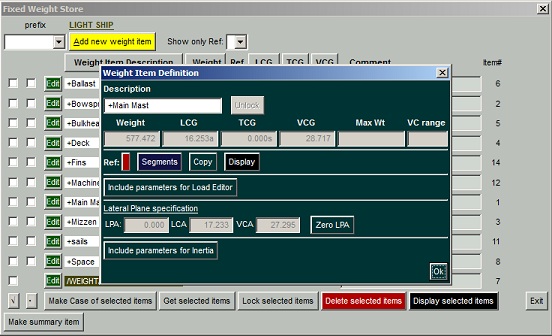
To save the trouble of going back and turning off the LPA option on every element, a new button was added to the dialog which zeroes the LPA for the entire item. |
|
|
Nothing is lost in zeroing the LPA there because it gets restored when you revisit
the "Segments" level.
Use DB UPDATE to get this feature. Also, the item numbers shown above on the right are new, which is a handy reference to have in one place. |
|
Questions, comments, or requests?
Contact Creative Systems, Inc. USA phone: 360-385-6212 Fax: 360-385-6213 Office hours: 7:00 am - 4:00 pm Pacific Time, Monday - Friday Mailing address: PO Box 1910 Port Townsend, WA 98368 USA Click here for an index to this and previous COWs |