
|
|
General HydroStatics
Ship Stability Software |
|
Command of the Week
(New or interesting aspects of GHS that you may not know about) |
|
RAH /RAMACRO
(Requires GHS version 19.16 or later ) |
|
GHS has so many commands and optional parameters augmenting those commands, that it isn’t always possible
to know the best way to implement a given procedure. Our goal for Command Of the Week (COW) articles
is to highlight aspects of the GHS command language that you can add to your repertoire.
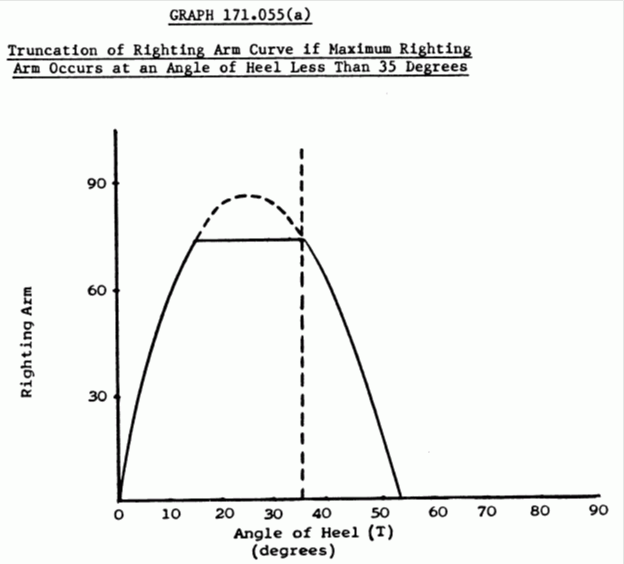
One of the most commonly used commands is the righting arm command, RAH (or just RA for short). It appears in nearly all GHS run files because it serves as the primary tool for evaluating the static stability of a vessel in a particular loading condition. LIMIT commands must be preset before running RA /LIM. The /LIM parameter triggers a comparison of the righting arm curve against the required characteristics. Users develop LIMIT commands to implement stability criteria from different organizations, such as their nation’s Navy, Coast Guard, or vessel regulatory agency. There are many similarities between the stability standards across these different agencies and the flexibility built into commands like LIMIT and HMMT is usually sufficient. However, on occasion, there are stipulations in the stability standards that are unique and not easily addressed by existing commands in GHS. For example, a German Naval Vessel standard refers to the righting lever in a seaway as the average of the righting levers with the ship on the wave crest and in the wave trough. This is where the RA /RAMACRO can be of use to insert a special-purpose sequence into the righting arm process. The additional exercise of calculating and averaging the righting arms with the wave in two positions has been in the example section of HELP RAH for many years. The help section for each command ends with examples of the different ways to use the command. Here are two other regulations that can make use of RAH /RAMACRO: • 46 CFR 171.055 Intact stability requirements for a monohull sailing vessel ... • DDS079 Stability and Buoyancy of U.S. Naval Surface Ships The sailing vessel regulation requires a truncation of the righting arm curve if the maximum righting arm occurs at an angle that is less than 35 degrees. |
|
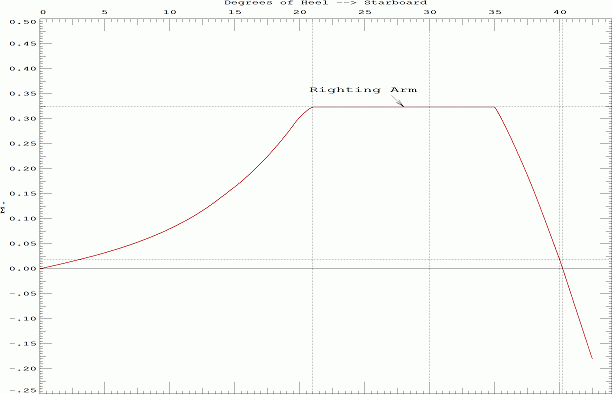
| An RAMACRO was used to create the truncated righting arm curve shown below. |
|
|
The NAVY damage stability regulation requires a cosine adjustment to the RA curve due to the “transverse shift
of loose material.” This could be accomplished with a temporary TCG shift or a merger of two heeling moment
curves (this damage criteria also has wind), but /RAMACRO can be used as well.
|
|
variable (length) TCGshift=0.05
variable RAH_RA macro raCosAdj2 SOLVE TRIM RAH_RA:=RAH-TCGshift*cos(HEEL)*RAAngDir / RA /LIM /RAMACRO:raCosAdj2 |
|
Did you know that MAXVCG also supports the /RAMACRO parameter? |
|
Questions, comments, or requests?
Contact Creative Systems, Inc. USA phone: 360-385-6212 Fax: 360-385-6213 Office hours: 7:00 am - 4:00 pm Pacific Time, Monday - Friday Mailing address: PO Box 1910 Port Townsend, WA 98368 USA Click here for an index to this and previous COWs |