
|
|
General HydroStatics
Ship Stability Software |
|
Command of the Week
(New or interesting aspects of GHS that you may not know about) |
|
GMTMMT /FSM
(Requires GHS version 19.16 or later ) |
|
When performing an inclining experiment, the normal procedure is to reduce free surfaces as much as possible by either emptying or pressing all tanks.
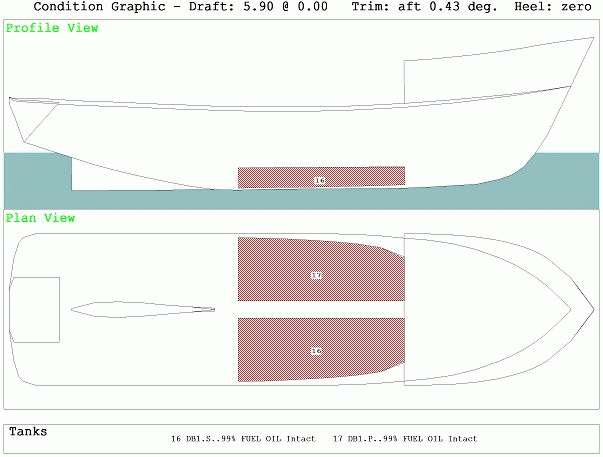
Did you know that free surfaces which are present during an inclining experiment actually decrease your lightship VCG? That is a strange statement, so let's dig a little deeper. We will compare two nearly identical inclining conditions. The loads are the same, but in one case, the cargo is liquid and in the other, it's frozen. The graphic and hydrostatics look the same for both of course: |
|

|
|
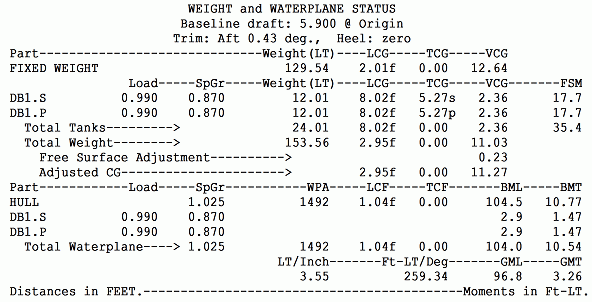
Below are the status reports for the two conditions. Which would you expect to have a lower lightship VCG? If the input to the GMTMMT command is the same then the case with the intact tanks will have the lower VCG. Take a look:
Here is the status for the case with liquid cargo: |
|
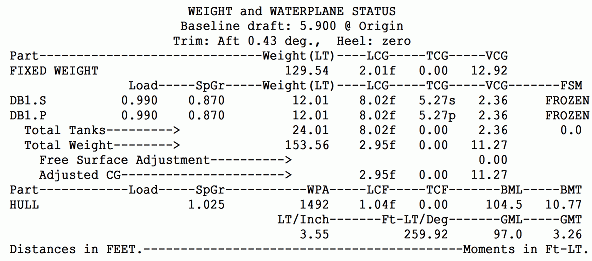
| Here is the status for the case with frozen cargo: |
|
|
When GHS calculates the metacentric height, the effect of any free liquids in tanks is included. The GMTMMT input for this case was 500, which results in a GM of 3.26 (500/153.56). Working backward from that GM, GHS finds the current metacenter (VCB+BMT) and subtracts the GM to get the current total VCG (3.75+10.54-3.26=11.03 for the liquid case). With the frozen cargo, the metacenter is higher (BMT of 10.77 compared to 10.54) while everything else is equal. Therefore, the total VCG is higher as well.
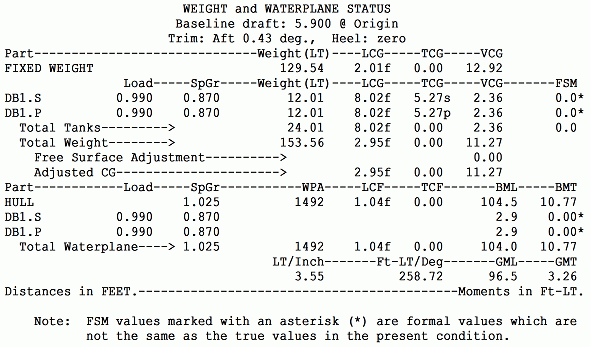
What if you are told to ignore those free surfaces, or assume that all the tanks have a free surface moment of zero? How could you do that in GHS? Well, you could always have changed the tank types to frozen, as in the above example, but now there is an even better way. You can use GMTMMT /FSM to force the use of formal free surface moments. Without the /FSM parameter, GMTMMT always uses true free surface moments, even if formal values have been established for tanks using the FSMMT command. The status report below is for the same condition, with liquid tanks, but with formal free surface values for DB1.P and DB1.S set to zero with FSM (DB1.P, DB1.S) 0 and using GMTMMT 500 /FSM. |
|
|
The real question shouldn't be can GHS do it, but why would we want to? GHS calculates free surface moments based on the tank geometry which is usually accurate enough, but if the liquid level is below the bottom structure or above the deck structure, then the effective free surface moment might be much less than the waterplane inertia calculation predicts. The reason is that the structure can reduce the distances that liquids can shift. With lightening holes, you wouldn't normally expect the bottom structure to affect the liquid's ability to shift. However, the above example is nearly full and perhaps lightening holes don't work when upside down.
Can you think of any other reasons why it might not be overly conservative to assume zero free surface moments in tanks during an inclining experiment? As you can see from the previous example, performing the GMTMMT command with zero formal free surface moments can be quite a penalty (lightship VCG of 12.92 instead of 12.64). So it's probably a good idea to completely eliminate liquids in tanks during the inclining experiment whenever possible. PS: If you have a feature that you'd like to see added to GHS, please send us a message at support@ghsport.com. |
|
Questions, comments, or requests?
Contact Creative Systems, Inc. USA phone: 360-385-6212 Fax: 360-385-6213 Office hours: 7:00 am - 4:00 pm Pacific Time, Monday - Friday Mailing address: PO Box 1910 Port Townsend, WA 98368 USA Click here for an index to this and previous COWs |