
|
|
General HydroStatics
Ship Stability Software |
|
Command of the Week
(New or interesting aspects of GHS that you may not know about) |
|
What is phase?
(Requires GHS with SK) |
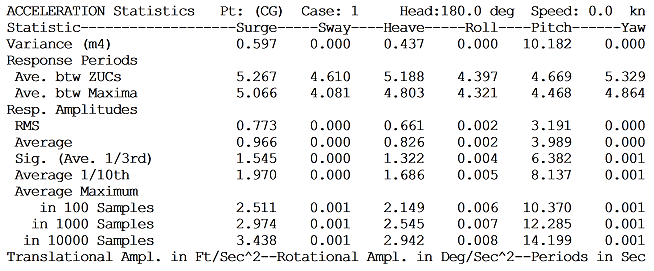
| In seakeeping, we are often interested in response amplitudes--things like maximum roll angles, or perhaps RMS heave accelerations. When using the SEAKEEPING command in GHS, a range of amplitudes are returned automatically in the Statistics tables in the report. |
|
| However, while an amplitude tells us how large the motion might be, it is only half the story. Scrolling through a seakeeping report you may have also noticed some odd-looking Phase Angle plots, such as the example shown below. While we often overlook them, phase angles are the other half of the story, but what does phase actually tell us? |

|
|
Phase angles tell us when the largest motion will occur relative to an incident wave. A phase angle is another way to show information about timing, and combined with the amplitude, we can recreate the motion in the time domain.
In GHS, we can do this by using the power of the SK.LIB macro library and the /DATA parameter on the SEAKEEPING command. We run a seakeeping simulation in a single sinusoidal wave with an amplitude of 1 meter and a period of 6 seconds, for example. |
|
wave (spe) 1,6
sea /data:wa,re /resp:p |
|
Looking in the report file, we can see that the phase angle for heave in this wave is 56 degrees. |

|
|
Then, we use SK.LIB to parse the WAve and REsponse data files that we created using /DATA.
|
|
run sk.lib /call /quiet
.sk.GetRespData "SK-RESPONSE.DAT" .sk.GetWaveData "SK-WAVES.DAT" |
|
Within a clever macro, we use some macros in SK.LIB to create a time domain realization of our motion (at the center of gravity) and the wave. |
|
macro TimeDomain
.sk.WaveElevation -26.8 0 {t} .sk.Position 3 CG {t} 0 1 CGPos:=sk.Pos me {t} {CGPos} {sk.WELEV} 0 t:=t+dt / |
|
Looping over this macro for a number of time steps, we plot the results. Notice that the heave motion is occurring before the wave crest. This is because the phase angle is positive: the heave is leading. Try experimenting by changing the wave period and you can readily see what the phase angle actually means. |

|
|
Now that we understand phase angles a little better, what use do they have? Other than conversions to the time domain, phase angles can be useful when checking the validity of the computed responses. For certain modes the phase angles tend to certain values in the long- and short-wave limits.
A complete run file of this example can be found here. |
|
Questions, comments, or requests?
Contact Creative Systems, Inc. USA phone: 360-385-6212 Fax: 360-385-6213 Office hours: 7:00 am - 4:00 pm Pacific Time, Monday - Friday Mailing address: PO Box 1910 Port Townsend, WA 98368 USA Click here for an index to this and previous COWs |